Smart Cities in the Age of Pandemic: Difference between revisions
Jump to navigation
Jump to search
No edit summary |
No edit summary |
||
| (7 intermediate revisions by the same user not shown) | |||
| Line 1: | Line 1: | ||
{{ | {{Report | ||
|Image=Smart_Cities_Pandemi.jpg | |||
| | |Published=2022-01-12 | ||
| | |Organization=Global City Teams Challenge, NIST | ||
|poc=Jiri Skopek | |||
| | |Where=Toronto Canada | ||
|Summary=This document outlines a simple, scalable approach that cities can use to integrate smart technology into the fabric of a city to enhance efficiency and livability in normal times and increase resiliency, capability and capacity in the age of pandemic. | |||
|sector=Wellbeing | |||
| | |chapter=Quality of Life | ||
| | |Release=Smart_Cities_in_the_Time_of_Pandemic_public.pdf | ||
This document outlines a simple, scalable approach that cities can use to integrate smart technology into the fabric of a city to enhance efficiency and livability in normal times and increase resiliency, capability and capacity in the age of pandemic. | |||
== | |||
}} | }} | ||
Latest revision as of 22:33, January 24, 2023
| Report | |
|---|---|
| Image | 
|
| Published | 2022-01-12 |
| Point(s) of Contact | Jiri Skopek |
| Organization(s) | Global City Teams Challenge NIST |
| Where | Toronto Canada |
| |
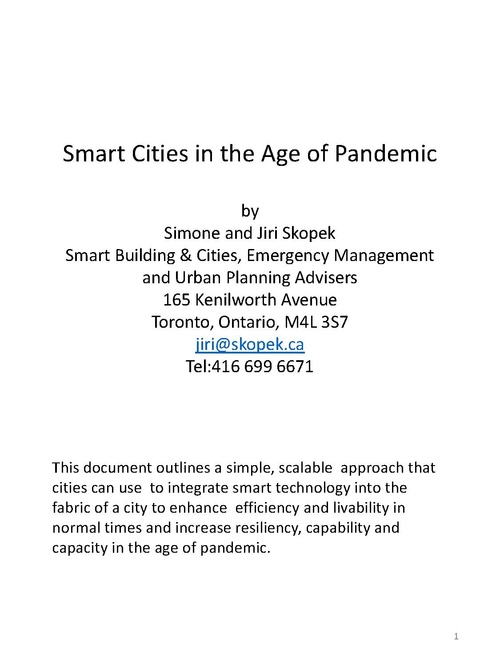
This document outlines a simple, scalable approach that cities can use to integrate smart technology into the fabric of a city to enhance efficiency and livability in normal times and increase resiliency, capability and capacity in the age of pandemic.